
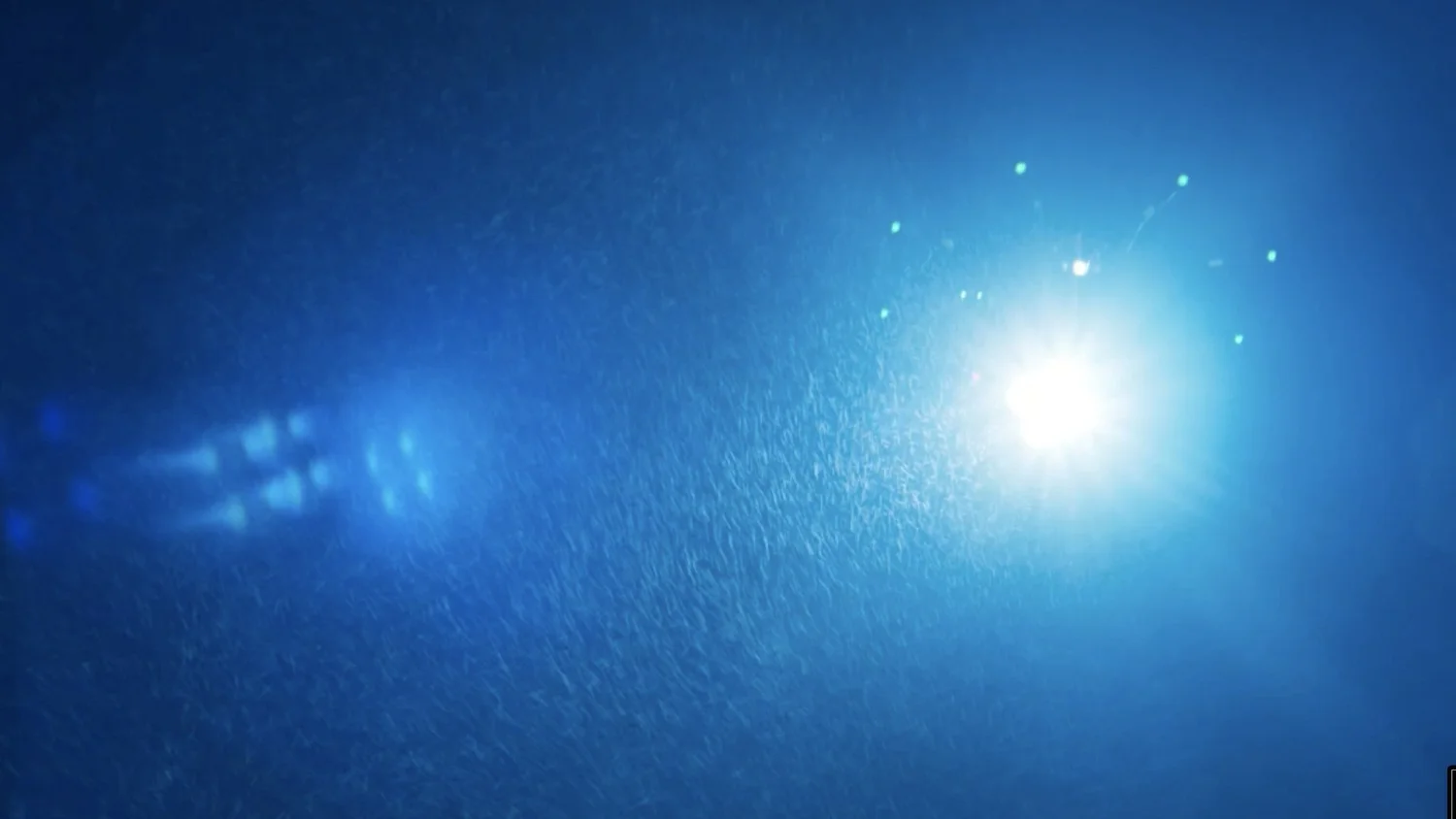
Drone lighting · Beyond Paradise, series 1 episode 4 · BBC One / Red Planet Pictures
In series 1, episode 4 of BBC's Beyond Paradise, directed by Sandy Johnson (Inspector Morse, A Touch of Frost, Jonathan Creek), something strange has left shapes in a cornfield near Shipton Abbott, and the village is convinced it was a UFO.
In the opening of the episode, a boy looks out of his window and sees the "UFO". That was our Freefly Alta 8, carrying a Movi Pro with a spotlight attached. The Alta 8 was both a prop drone and part of the lighting for the scene: a 100,000-lumen LED array flown over the crop, so the light came down on the scene like something was hovering there. Watch the episode on BBC iPlayer.
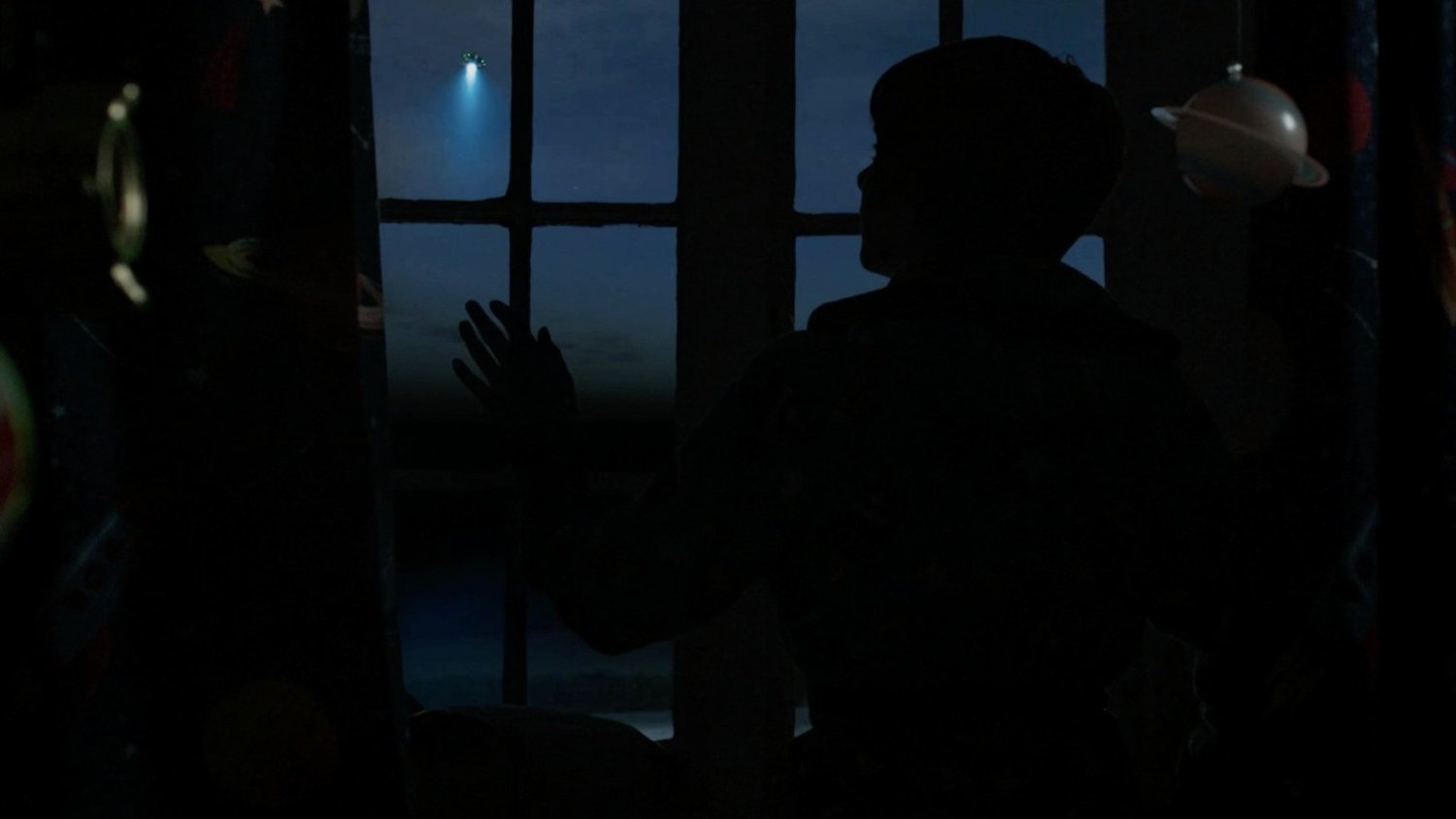
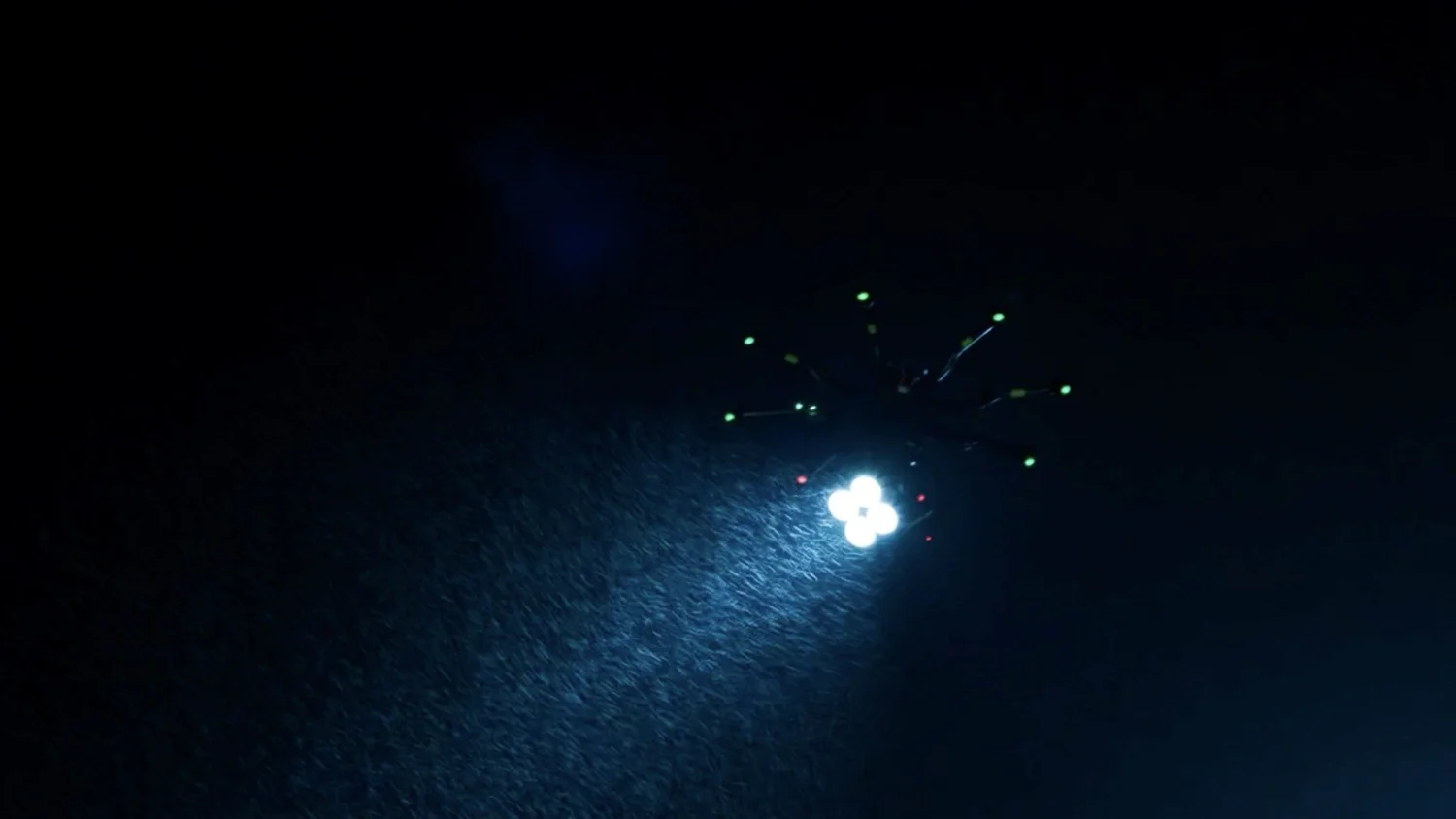
We were shooting in a large cornfield on the Devon border. It was early autumn, so it took a while for night to kick in, and we were a little hampered by light drizzle, which you can see in some of the frames. When the drone first went up and the light hit full beam, there was a lot of excitement. Let's not forget, this kind of equipment is brand new to film sets, and it's really cool.
Everyone loves to play with light in a creative way. The storyline, written by Ian Kershaw, had us flying the drone as an on-camera prop, which needed timing and choreography, and as the lighting for the scene, which had to be timed perfectly, while also flying a second drone to capture the sequence.
Lighting aside, there were a lot of moving parts, and the aerial plan had to be spot on, and safe.
The plan
Drone lighting only works when it's part of the lighting plan, not a stunt bolted on at the end. Night shoots are generally not over-lit or multi-source, and to really get the effect of a drone light you need a simple approach.
Low ambient. A low ambient spread or a high, soft moon, balanced to the DOP's taste. We have to give the light a chance to work its magic.
How bright. The lights have dimmers. At full beam it landed somewhere between a Joker 800 and a 1.2K HMI. Add diffusion or cones to shape it.
Colour. 5500K daylight. On some of our LED units we can swap the protective glass to get 4600K or 4200K.
Cues. When it comes on, how it moves, and how it's dimmed during the take. An onboard FPV camera lets us aim the light, and it sits on a Movi, so it stays stable.
The kit
The light was a StratusLEDs 2X2 Array: four 150W LED emitters putting out 100,000 lumens. It's built to be paired with a stabilised gimbal and a drone, so it sits in a Freefly Movi Pro under the Alta 8 and can pan and tilt in flight, giving real control over how the light moves. Some other drone lighting rigs don't allow for this, so if the drone hits a gust of wind, the light moves with it. Mounted on a Movi Pro is best practice.
Drone: Freefly Alta 8 heavy-lift
Light: StratusLEDs 2X2 Array, 4 × 150W LED emitters
Output: 100,000 lumens
Colour: 5500K daylight (4600K or 4200K with swapped glass), takes gels
Control: dimming over R/C PWM, DMX-512 or WiFi; pan and tilt in flight
Aiming: FPV camera on the gimbal, so the operator sees where the light points
Flight time: 12 minutes flying, 15 minutes of light at full beam
One pilot flies the drone while a second operator aims and dims the light, watching through the FPV camera. That keeps the light where the gaffer wants it, take after take.
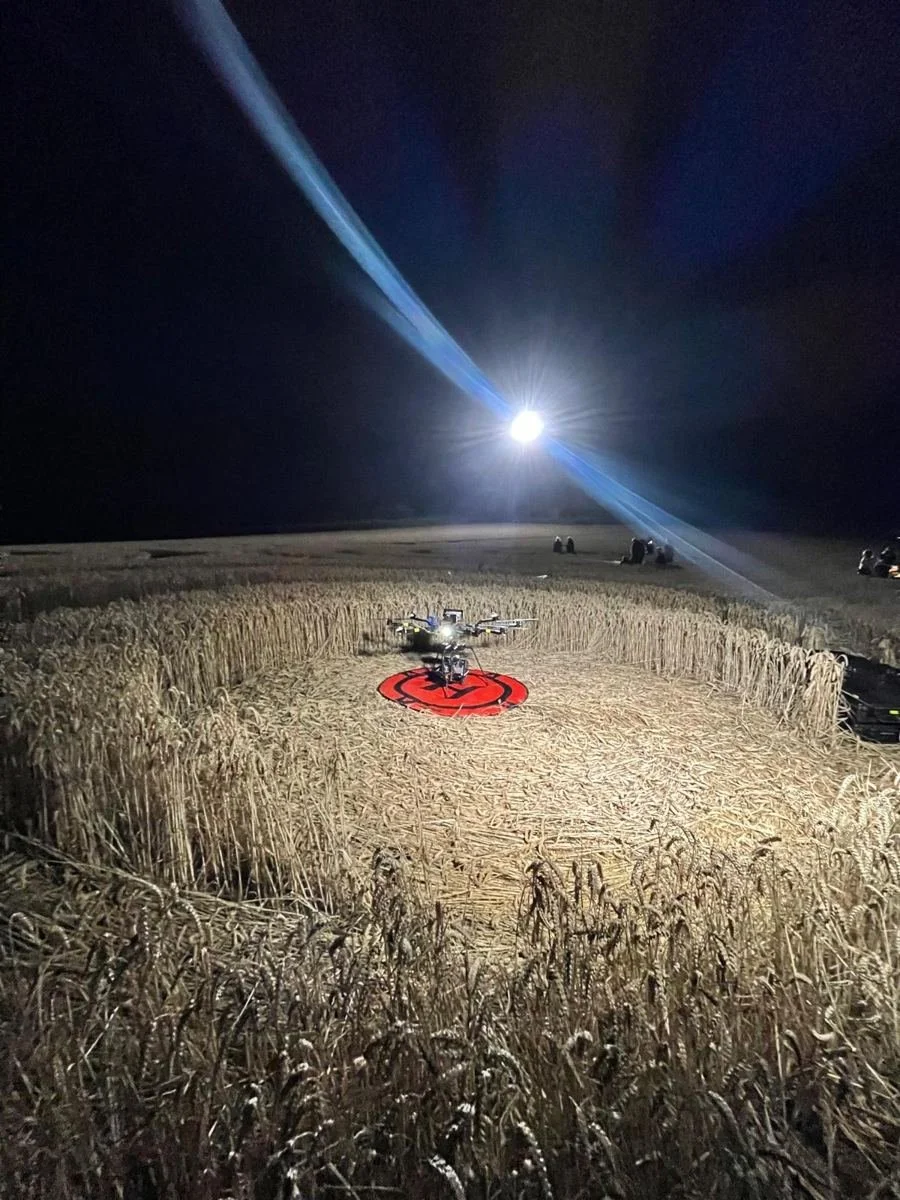
Behind the scenes: the Alta 8 on its pad in the crop circle.
On the night
We were on site from midday, making on-site assessments and firming up the plan. It was dry, with light winds.
On the first test flight we had to line up the two main cameras and the drone light, and decide between diffusion or bringing up the ambient light. The plan was to keep the spot bright: in the story it was "blinding".
We had limited takes because of rain and mizzle. Nothing quite like getting two or three goes to nail a whole sequence.
We're used to that kind of pressure. Drone is often "last up", with minutes left to deliver what's needed.
The team: Alta 8 pilot, Movi Pro light operator, Inspire 2 pilot and Inspire 2 camera operator.
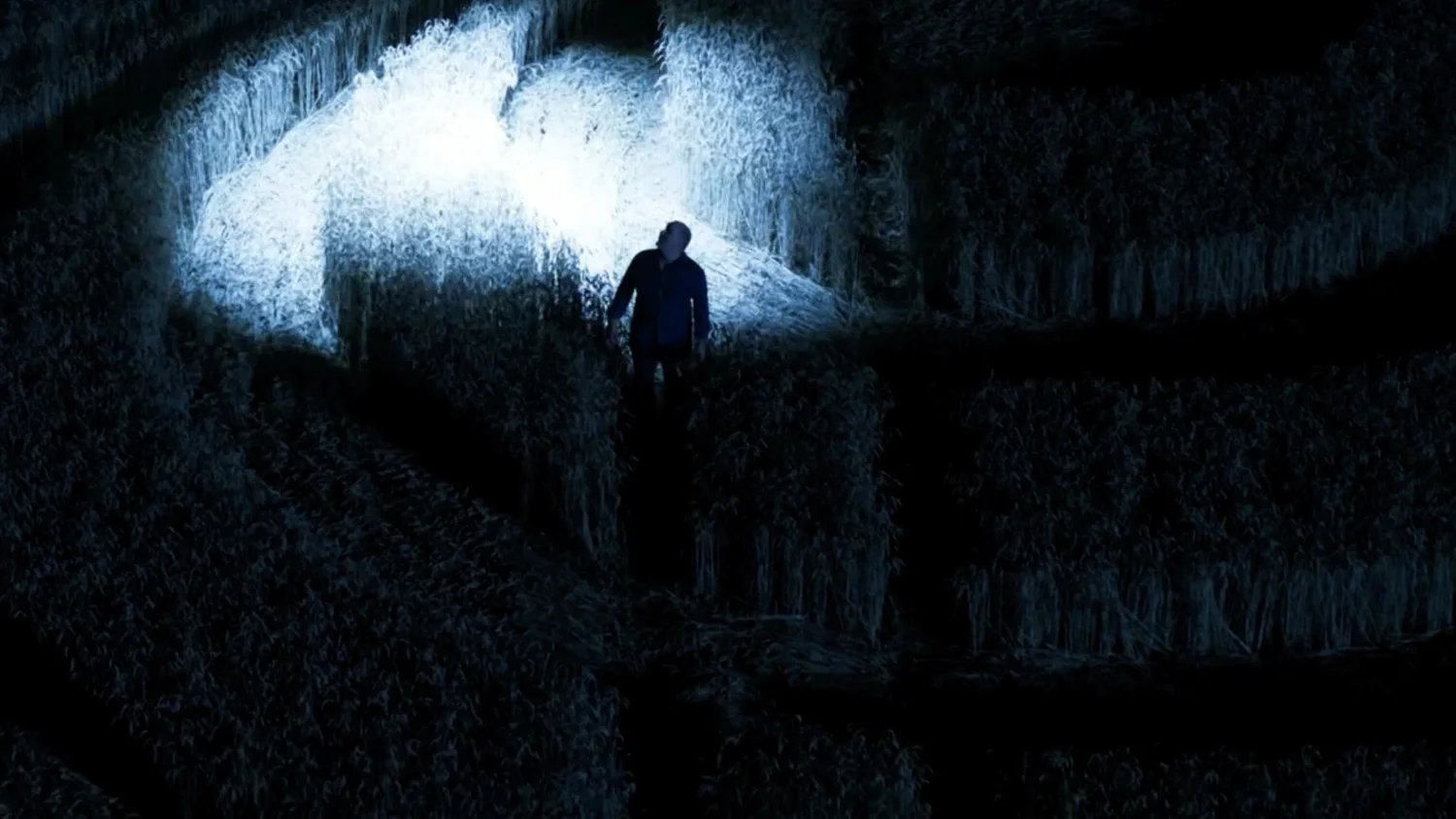
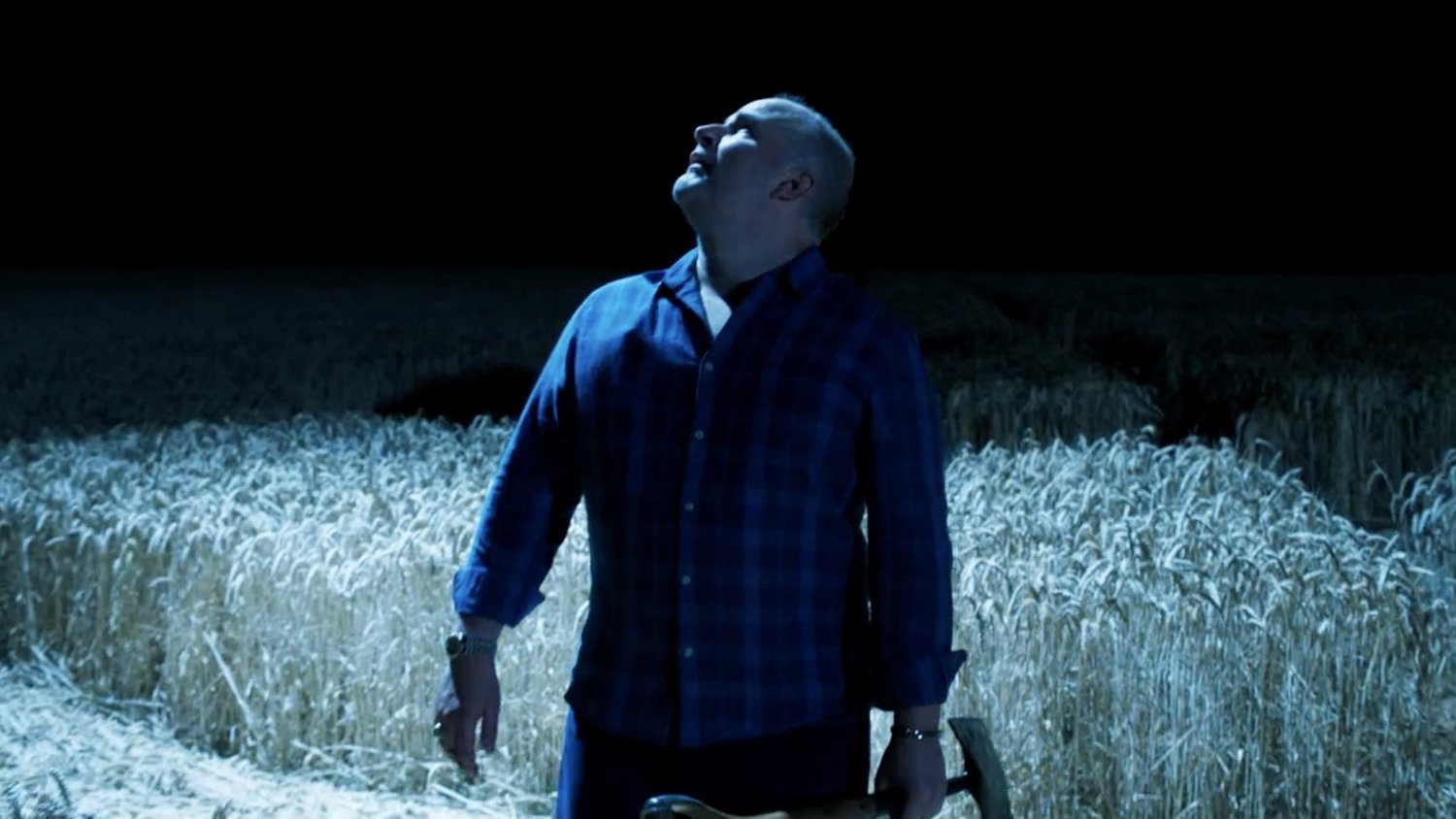
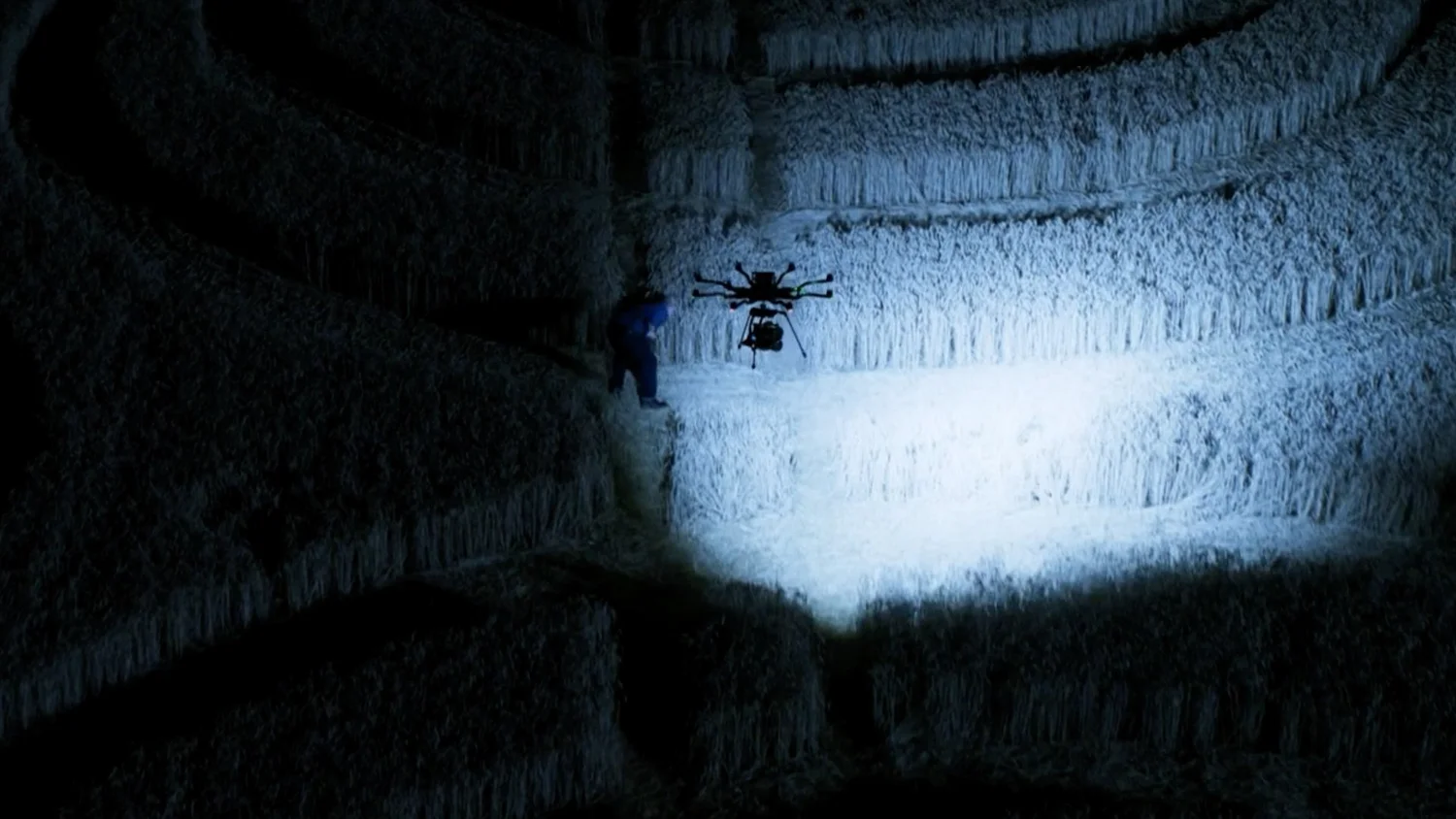
Frames from Beyond Paradise, series 1 episode 4 · BBC / Red Planet Pictures
Where drone lighting is now
Drone lighting has come on a bit since that cornfield. We now fly three lights, each suited to a different job.
LED array · Alta 8 or Alta X · 100,000 lumens. Creative lighting and larger coverage. Great for spotlights and moving shadows.
Compact light · DJI Inspire 2 or Inspire 3 · 24,750 lumens. Closer shots when the big light can take a rest; tighter shots on cast while a spotlight scans the scene.
FPV light · FPV drone · 14,000 lumens. Fast moves and creative lighting orbs.
The biggest change is that the Inspire 2 and 3 can carry a single 150W LED on a tilting gimbal. That, and the fact that most cameras can now shoot dual ISO, really opens up creative lighting to lower budgets. On bigger sets it also means we can offer up the Inspire 2 to cover some shots. Let's face it, the big rig is slower, more power-hungry and a bigger job as a whole.
The lights are 5500K daylight and take gels. The 150W Air Module weighs 490 g, is flicker-free on high-speed cameras and can strobe at up to 500Hz, which opens up lightning and effects work for slow-motion capture. It dims over DMX-512, Art-Net or R/C PWM, so if it's rigged on a jib instead, it can sit on the same desk as the rest of the lighting.
Got a night exterior coming up?
We plan every lighting flight with the gaffer, so the drone becomes another unit in your lighting plan. Every job is different, so we quote each one: tell us the shot, the location and the timings.
I'm always up for a chat and love getting creative with lighting and drones. Add some haze and everyone's excited.
Tim
See drone lighting → · Talk to us about your shoot → · WhatsApp 07983 706452
Light specs: StratusLEDs 2X2 Array · StratusLEDs 150W Air Module