
Safety and permissions
Safe and experienced, on every shoot
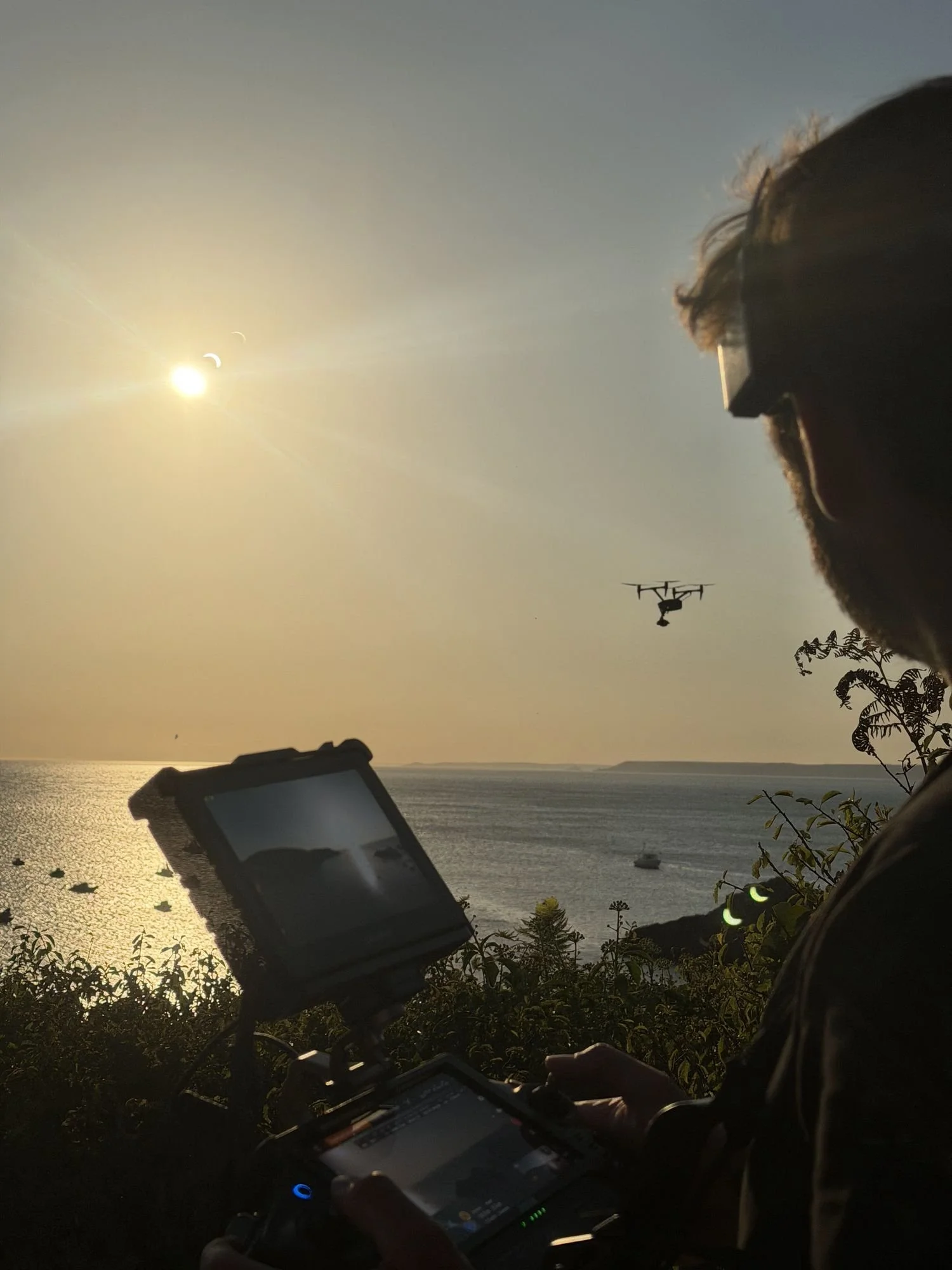
Every flight we make is planned, risk-assessed and insured before we arrive. We're known for making things happen, not creating problems. Here's how a drone job works with us, from your first call to wrap.
The short version
CAA-authorised
We fly under our own CAA Operational Authorisation
Fully insured
£5m public liability, which can be raised to £10m, plus drone and employer's liability
Planned in writing
A risk assessment and flight plan for every job
On set since 2012
TV, film and commercials across the UK and in 30+ countries
Firsts. We were first to get drone filming permissions in Iceland, the Dominican Republic and Jamaica, and first to take a UK drone to film in Mauritius, Malta and Crete. Places we were told it wasn't possible, done legally and safely.
How we work
From first call to wrap
Ten steps. The permissions and paperwork sit in steps 3 to 6, all before the shoot day.
- 01
Your enquiry
Tell us the shot, the location and the dates. We'll tell you straight away the right drone for the job, whether the location needs simple or extended permissions, and the lead time.
- 02
Your quote
A clear price, with our rate cards on request. TV and film work is on 30-day terms. Direct clients pay a 50% deposit when booking, or at the latest 24 hours before the shoot.
- 03
Desk survey
Before anything is set in stone, we check the location from the office: airspace, airports and no-fly zones, notices to pilots (NOTAMs), danger areas, roads, railways, power lines, SSSIs, heritage sites and seasonal restrictions. It also shows us where the public are likely to wander in, and what will draw a crowd.
- 04
Take-off permissions
We confirm who owns the land we take off from and fly over. On TV and film sets your location team often arranges this. If not, we can secure landowner permission, and advise where a shot could be achieved from a boat instead. Where Natural England seasonal restrictions apply, we set out a clear plan, propose a site visit and build a flight and shot plan that keeps everyone happy.
- 05
Airspace permissions
Most locations need none. Busy airspace and cities can need up to 30 days. Abroad, a country with no drone permission system in place can take 60 days. Most countries follow similar rules but use different paperwork, so tell us early.
- 06
Risk assessment and flight plan
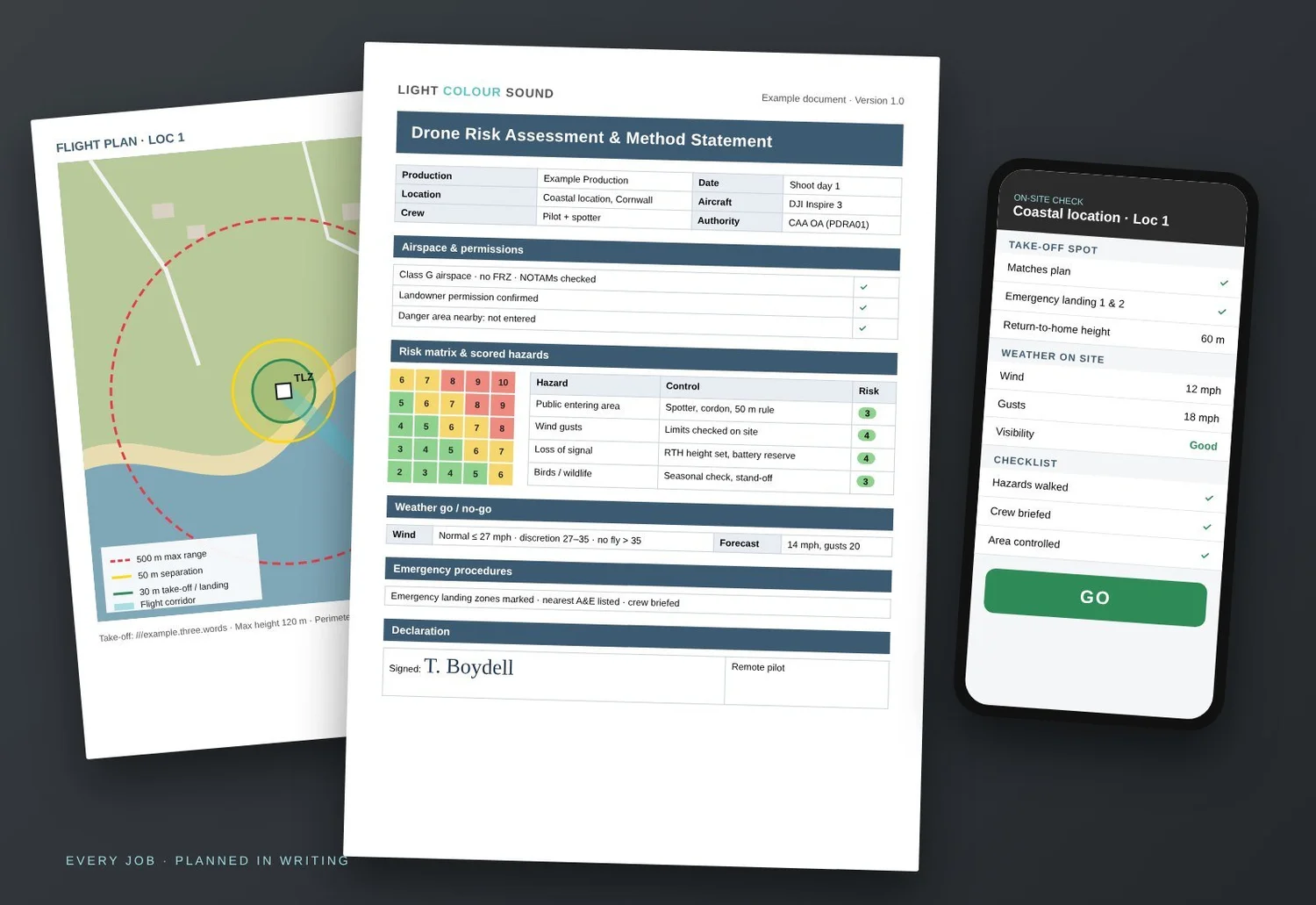
We write a risk assessment (RAMS) for your job and a mapped flight plan showing take-off points, flight areas and safety distances. They go to your production, and to the landowner if needed, ideally 5 working days before the shoot. If plans change on the day, we can write a dynamic on-site RAMS for priority changes in under an hour.
- 07
Weather
Weather changes and nobody can control it, so we keep you informed. You get the forecast 7 days out, our recommendation at 5 days, and a detailed forecast with our view at 3 days, when the booking goes ahead or is postponed under our terms. At 24 hours we give a final update and re-check the NOTAMs, which can change at any time.
- 08
On the day
Before we fly, the pilot checks the take-off spot and emergency landing spots, measures the wind and walks the hazards. We brief the production team clearly, control the flying area and make the final go or no-go call.
- 09
Flying
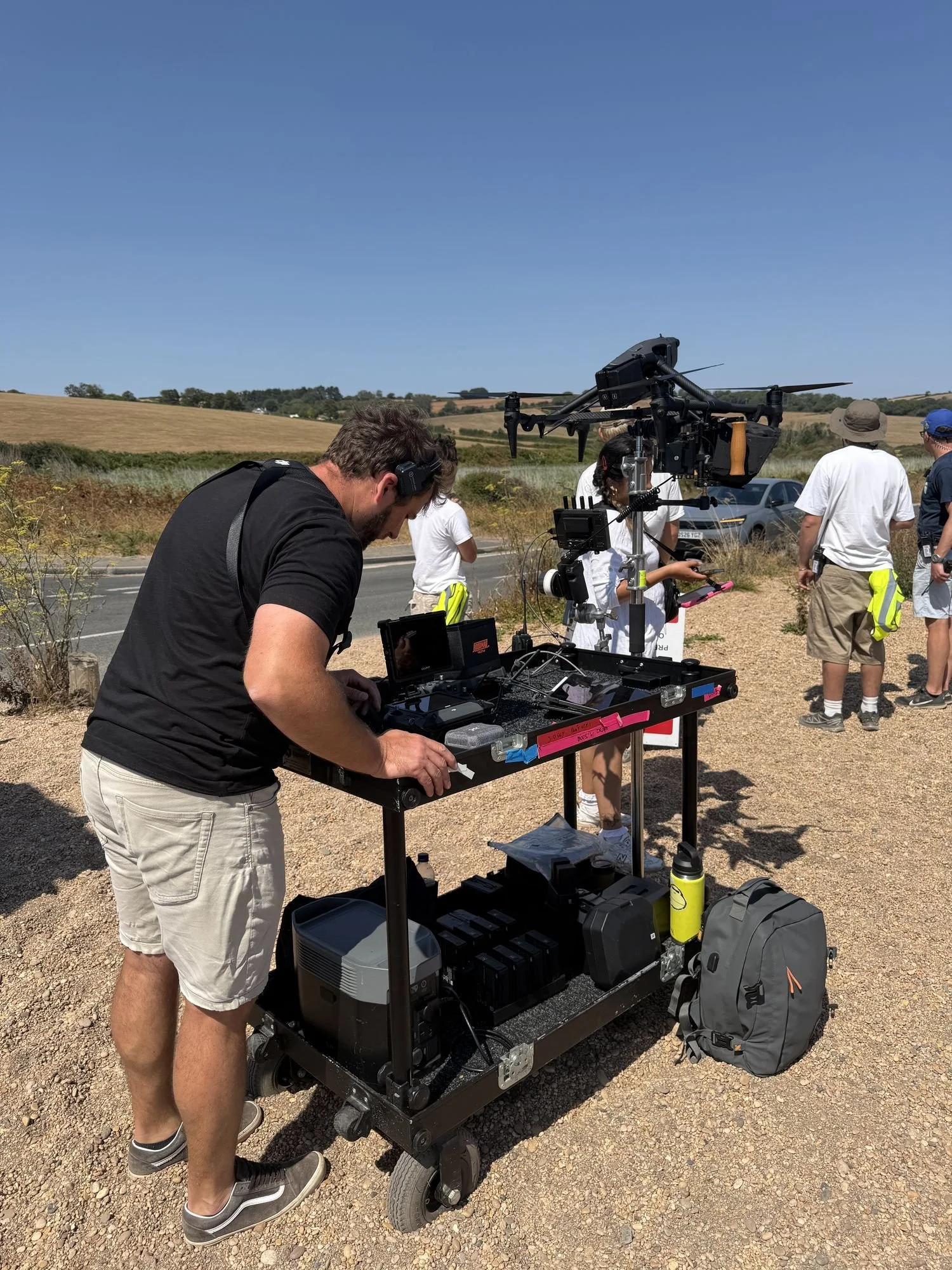
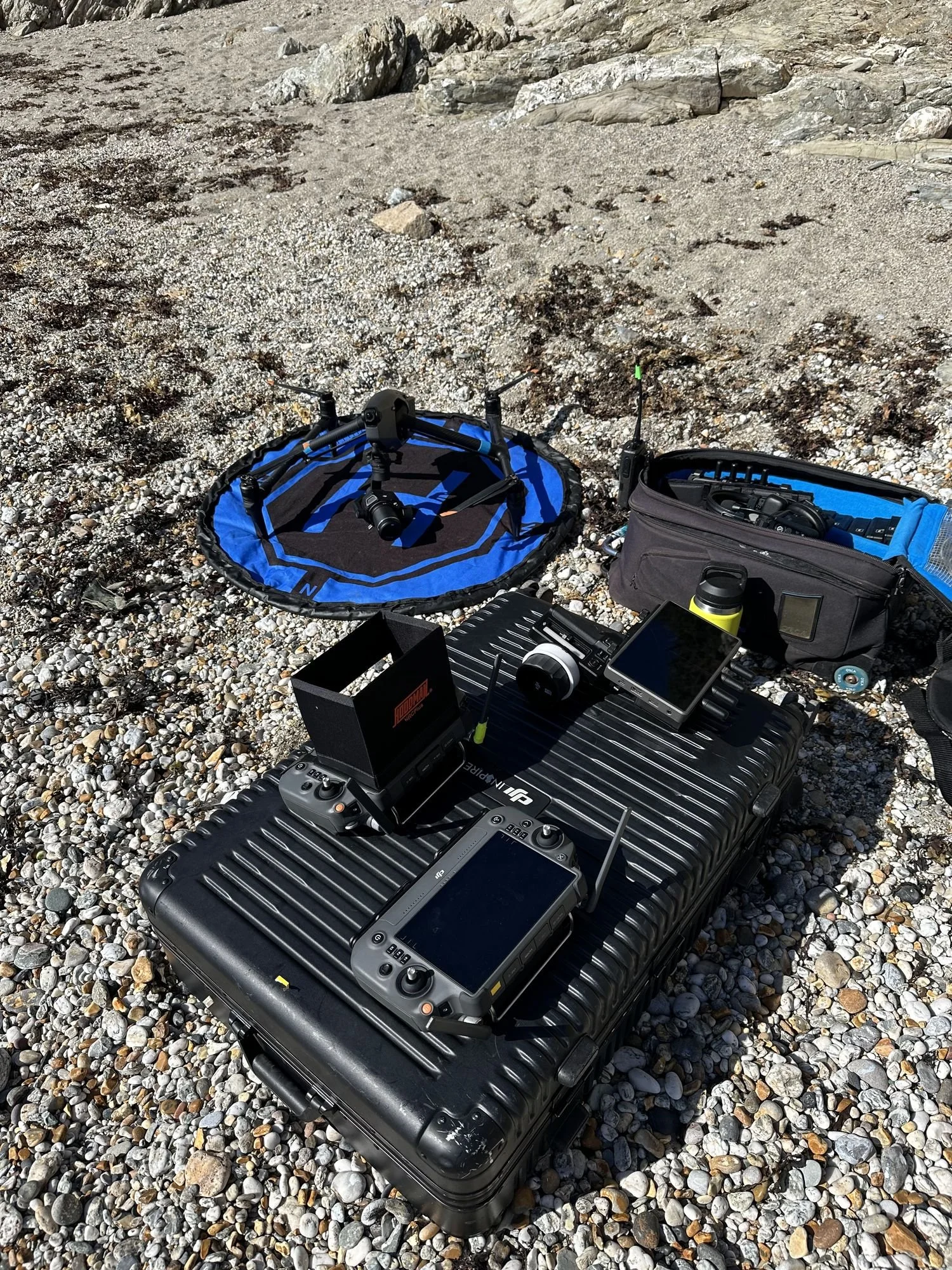
An experienced pilot and spotter on every job as a minimum (the spotter is sometimes supplied by production), safe distances kept from anyone not involved, and clear calls with your 1st AD or director. After each landing the area is cleared, batteries are logged and the next flight is prepped. For repeated running shots we hot-swap batteries on the Inspire 3 and Alta for a quick turnaround.
- 10
Wrap
Footage is handed over on the day or as agreed, on cards clearly marked and taped inside a Peli case. Every flight is logged and the paperwork kept ready for a CAA audit. The invoice follows.
Our permissions, in plain terms
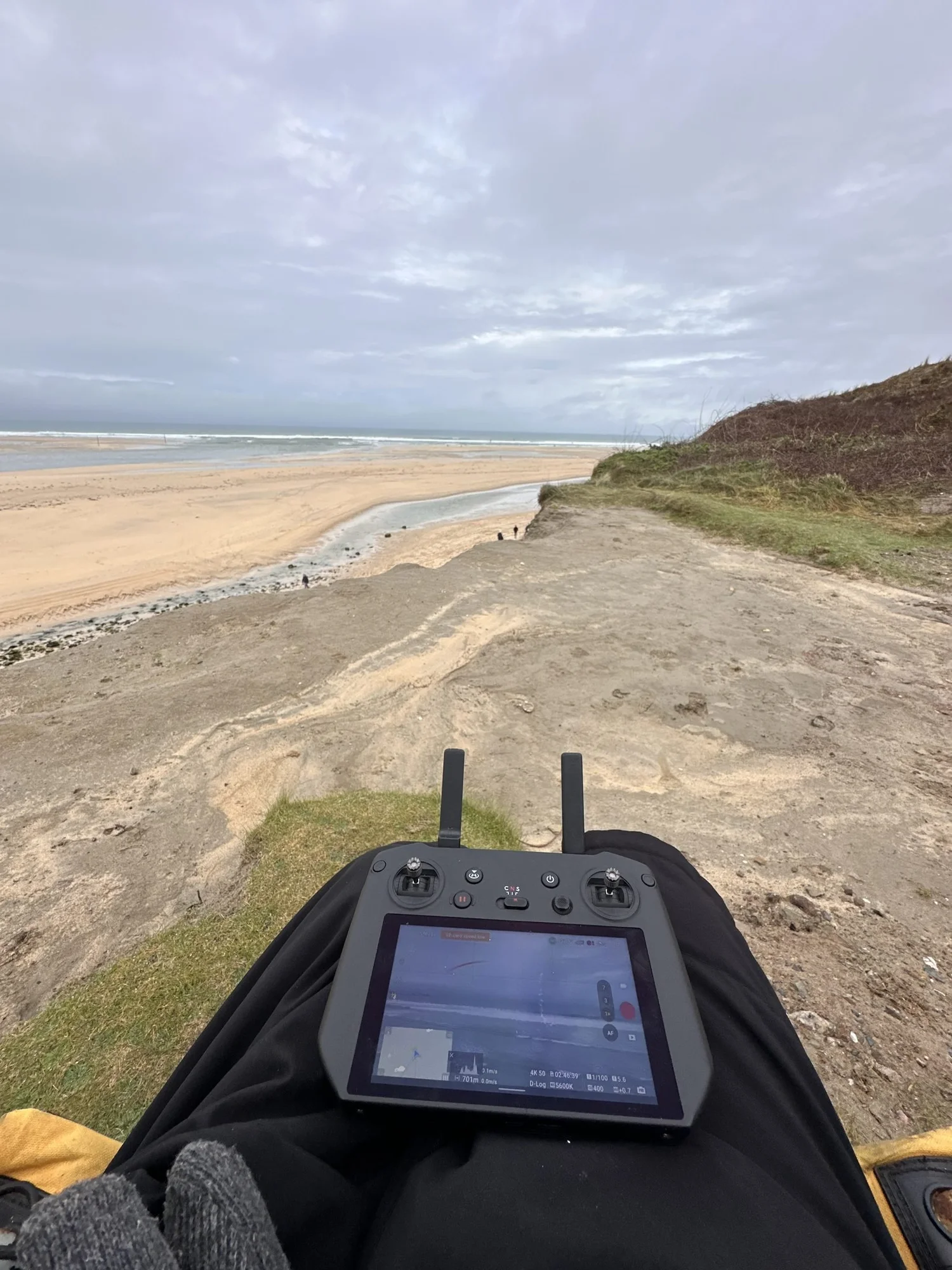
We fly under our own CAA Operational Authorisation. As standard it lets us:
| Fly up to 120 m high | Enough for almost every aerial shot |
| Fly up to 500 m from the pilot | The drone stays within the pilot's sight |
| Keep 50 m from people not involved | Briefed cast and crew can be much closer; the public stays back |
| Keep 30 m at take-off and landing | We pick take-off spots away from the public |
| Fly at night | With lights fitted and extra planning |
| Fly near airports and restricted zones | With permission from the airspace owner, which we arrange |
Closer, busier or more complex jobs
For filming nearer the public, in towns and cities, or in parts of London, we can fly under an Operating Safety Case (OSC) at additional cost. Tell us early and we'll plan for it.
Our pilots
Our pilots hold the CAA's GVC and A2 CofC and are registered with the CAA. For Europe we also hold EASA A1/A3 and A2 certificates, and can apply for specific operation permissions in countries such as Italy, Spain and France. Ask us about your location.
Insurance
Covered for the work we do
We'll send our certificates with your RAMS on request.
Public liability
£5m as standard, which can be raised to £10m for your production.
Drone liability
Third-party liability insurance on every drone job.
Employer's liability
£10m.
Equipment and vehicles
Our drones are covered by our drone insurance, and our vehicles are insured. Cover for hired-in kit or your production can be arranged per job. Tell us early if you need higher limits or your company named on our policy.
What we need from you
The more we know early, the faster the paperwork. Send us:
- The location, with a postcode or What3Words for where you'd like us to take off
- Your shot list, or a rough idea of the shots
- Dates, call times and any time windows such as tides, light or road closures (we can advise on these too)
- A production contact, and your location manager if you have one
- Whether cast, crew, the public, animals or vehicles for the shoot will be near the flight
- Any permissions you already have from the landowner
Good to know
What wind can you fly in? It depends on the drone. Our Inspire 3 flies normally up to 27 mph, at the pilot's judgement up to 35 mph, and not above that. Smaller drones have lower limits. We check the forecast in the days before and measure the wind on site.
Can you fly in rain? Yes, with the right drone. We have access to rainproof heavy-lift drones for wet-downs and rain scenes. Our standard drones can handle very light rain, but in any rain water reaches the lens quickly, so we may be able to fly while the footage isn't usable. We never fly in conditions that put the drone or people at risk.
Can you fly at night? Yes. Night flights need lights on the aircraft and, where possible, a daylight look at the site first. With the Inspire 3's dual native ISO, night footage looks superb.
Can you fly over people? We don't fly over the public. Briefed cast and crew can work much closer, and for tighter shots near the public we can fly under an Operating Safety Case at additional cost.
What about privacy? Every risk assessment covers privacy. We plan flights to avoid filming people who aren't part of the shoot, and follow the CAA's guidance on data protection.
Can you film near airports or in London? Yes, with permission from the airspace owner. These jobs need more notice, so tell us early.
Do you handle location permissions? On TV and film the location team usually does. We can secure landowner, National Trust and airspace permissions ourselves when needed.
Will you send your RAMS and insurance? Yes, as standard, before the shoot.
Planning a shoot?
Send us the location and a description of the shot. We'll tell you what's possible, what permissions it needs, and get the paperwork moving.
Talk to us about your shoot